Written by: PGA Procedural Documentation Desk
Reviewed by: PGA Editorial Board (Zaheer Aujla, Head of Board)
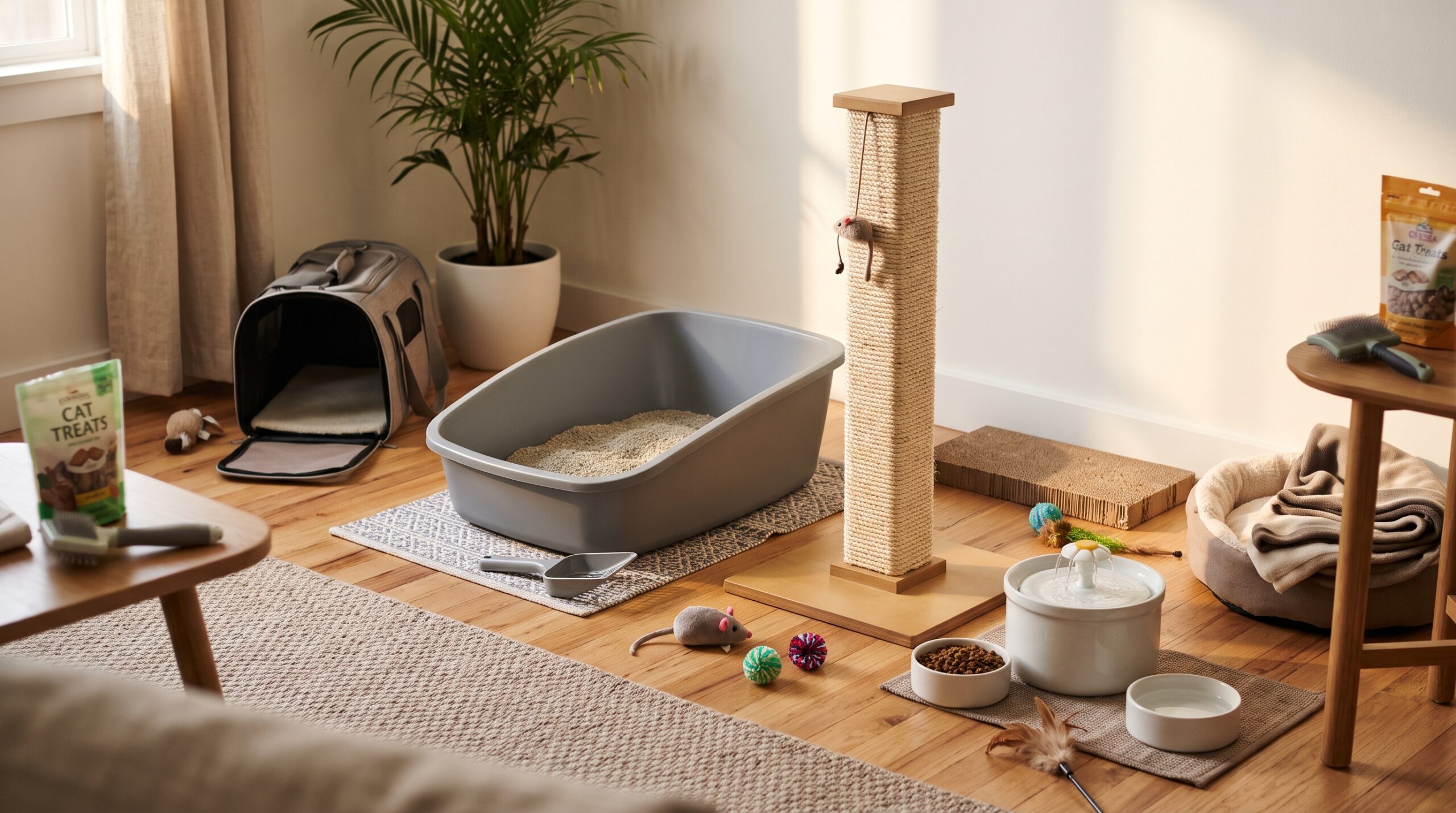
The essential supplies for a new cat are not a shopping list. They are the physical components of a territory, and the animal arriving in your hallway has roughly 48 hours to learn how to read it. A cat is a semi-domesticated solitary hunter with a fixed hierarchy of environmental requirements, and those requirements do not negotiate with human convenience. Fail to meet them and the animal will not complain. It hides beneath a sofa instead. It stops eating. It begins eliminating in places you will discover weeks later. No list of essential supplies for a new cat matters if the animal cannot eat, eliminate, and observe from cover. The supplies you buy in the first week are infrastructure: the litter geometry, the vertical escape routes, the water the cat will actually drink. Everything else is decoration. This protocol sets out the essential supplies for a new cat in the order the animal needs them, along with the placement rules and contraindications that decide whether it settles or fails.
Section 1: Clinical Answer & Immediate Triage
Buy in sequence, because each item corrects a failure that compounds if ignored. Essential supplies for a new cat begin with a large uncovered litter box in a quiet room, followed by a vertical sisal post tall enough for a full stretch, a stainless steel fountain separated from the food station, shallow ceramic bowls, and two concealment points the cat can occupy without being reached. Toys and beds are optional and can wait a month without consequence. If the cat stops eating, avoids the box, or stays hidden past 24 hours, the environment is failing and no further purchase will repair it. The three triage items below address the most common first-week breakdowns in the essential supplies for a new cat sequence.
If your new cat refuses to eat due to stress: Purina Pro Plan FortiFlora
(affiliate link)
If you need to clean the litter box safely: Earth Rated Dog Wipes (safe for cats)
(affiliate link)
If your cat is shedding heavily from stress: Chris Christensen Big G Slicker Brush
(affiliate link)
Section 2: The Environmental Moat (Feline Territory)
Veterinary ethology treats the domestic cat as a territorial generalist that survives by controlling access to resources rather than by defending a perimeter. A house, to a cat, is not a home. It is a set of resource nodes, and each node must be separated from the others by distance and by sightline. Feeding happens in one place. Elimination happens in another, well away from it. Water sits somewhere else again, because cats will not drink where they eat if an alternative exists, and they will not eliminate where they eat under any condition. Put a bowl, a fountain, and a box in one corner and you have built a single contaminated node. The cat will resolve that conflict by abandoning one of the three, and it is almost always the box. Most first-month litter box failures are architectural, which is why every entry on the essential supplies for a new cat list maps to a specific zone. The onboarding sequence continues in our guide to kitten care and the new owner guides.
The second structural requirement is verticality. Cats are arboreal predators with a documented preference for elevation when they assess threat. A cat that can reach a shelf, a cat tree platform, or the top of a bookcase controls the room without touching it. Confine an animal to floor level and you create a state of low-grade vigilance that runs all day, suppressing appetite and play. The essential supplies for a new cat that build vertical territory are the ones owners most often skip. Height without concealment is a lookout with no bunker. Concealment without height is a bunker with no view. Build both.
The third requirement is concealment, and it is where suppliers routinely mislead buyers. A cat’s sense of safety is calculated almost entirely by the availability of hiding spots it can enter and exit on its own terms. A cardboard box with one cut door outperforms an expensive open bed every time, because a box lets the animal control its exposure. Hooded litter boxes get marketed as comfort products. Ethologically, a hood traps ammonia at nose level, and repeated ammonia exposure produces aversion that no amount of scooping fully reverses. The cat needs a hiding place, not a sealed chamber. The essential supplies for a new cat that address concealment cost almost nothing. Place concealment beside every resource so the animal can monitor its own territory from cover, then leave it alone.
Section 3: The Procedural Timeline (The First 48 Hours)
The first 48 hours are a containment exercise. Cats build a cognitive map by exploring outward from a secure origin, and every unfamiliar square foot gets processed as threat until proven otherwise. Release a new cat into an entire house on day one and it will attempt to process thousands of square feet at once. The predictable result is an animal that selects a permanent hiding point and stops eating. The four stages below sequence the essential supplies for a new cat into an order that matches how the animal actually reads a room. Each stage depends on a specific purchase, and each must be complete before the next begins.
3.1 The Base Camp Setup (Hours 0 to 2)
Pick one room with a door that closes. Quiet. Away from the front entrance. No guests, no children, no resident pets. This is base camp, and for two days it is the whole known world. Carry the animal in its carrier and set the carrier on the floor. Open the door. Then step back and leave the cat alone. It will come out when the room stops registering as a threat, and that may take four minutes or four hours. Litter box at the far end. Food and water at the other, with clear sightlines between them and as much distance as the room allows. Put the vertical post against a wall the cat can use to launch. Two hiding points, one at floor level and one elevated. Dim the lights and keep voices down. Skip the toys and let nobody visit. Base camp is where the essential supplies for a new cat either work together or fail together, and it should contain nothing the cat cannot control.
Procedural Check: The essential supplies for a new cat that matter most in hours 0 to 2 are the box, the hiding points, and the separated food and water. Confinement prevents hiding under inaccessible furniture and litter box avoidance.
3.2 Litter Box Protocol (Hours 2 to 8)
Among essential supplies for a new cat, the litter box is the most often botched purchase. One box per cat, plus one. A single cat in a single-story home needs two boxes in two separate locations, which removes the single point of failure. Size matters more than style. The box should run at least one and a half times the cat’s length from nose to tail base, because the animal has to turn around and dig without standing in waste. Uncovered is the default. A hood concentrates ammonia at the level of the cat’s nose, and aversion follows within days. Use three inches of unscented clumping litter, the texture closest to what cats choose when given a choice. Scented litter is a marketing category. Scoop twice daily, which is the strongest single predictor of continued compliance, and wash the box weekly with unscented soap. Site it in a quiet, low-traffic spot with escape routes in two directions. Never put it beside the food station or in a closed closet.
Procedural Check: Essential supplies for a new cat fail most often at the box. Use a large, uncovered litter box in a quiet, low-traffic area separate from food and water, and scoop twice daily.
3.3 Scratching Infrastructure (Hours 8 to 12)
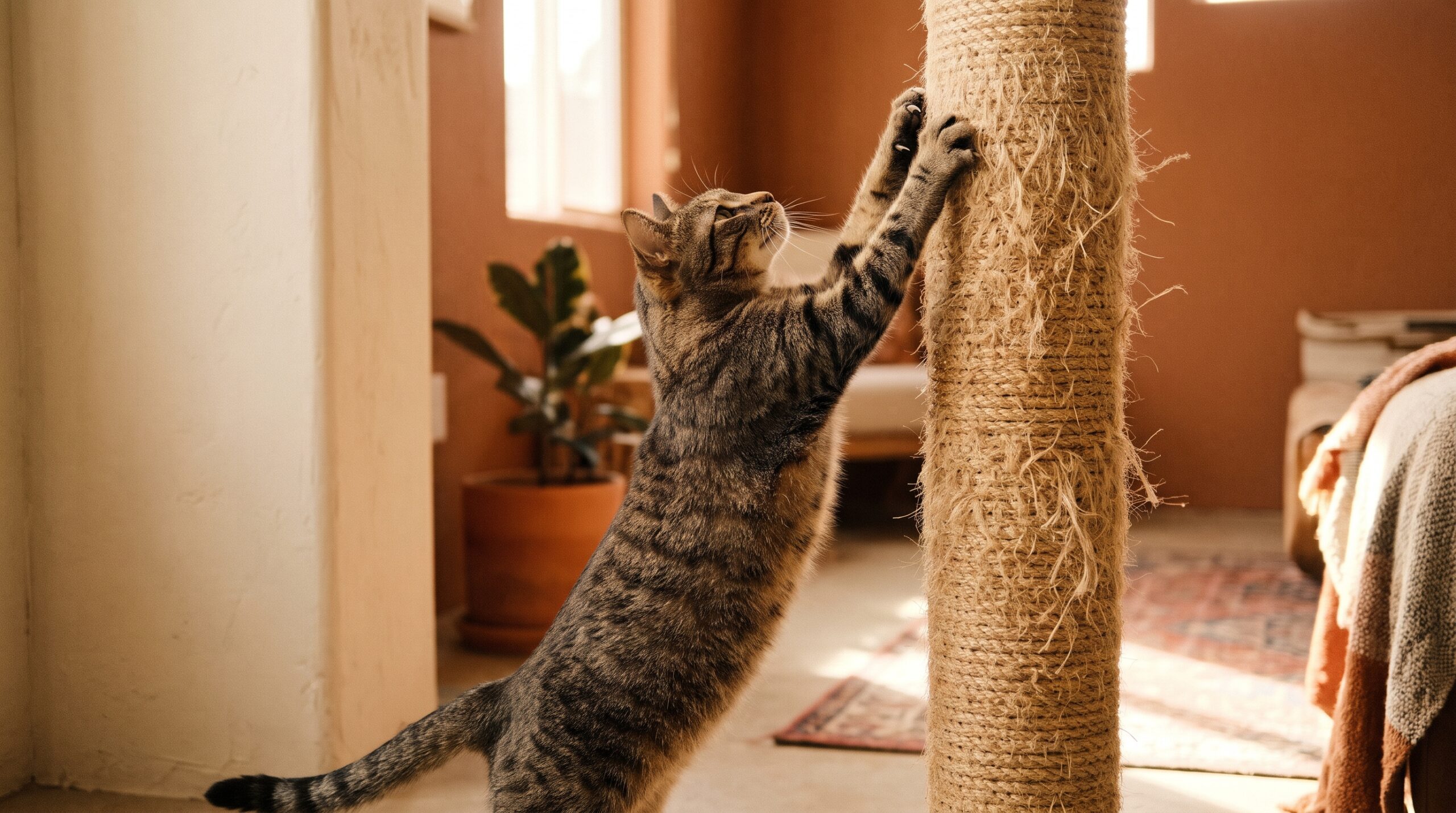
Scratching is maintenance and communication, not a behavior problem. The cat sheds the outer sheath of the claw, stretches the shoulder and back, and deposits scent from glands between the toes. Provide an approved surface or the sofa becomes the approved surface, because the sofa is simply the largest vertical substrate in the room. The vertical post has to be tall enough for a full stretch with the front paws extended overhead, which for most adults means 32 inches or more. A short post forces scratching at floor level and offers no territorial advantage. Sisal rope is preferred because it shreds into fibers instead of splintering. Add a horizontal scratcher for cats that prefer to dig while lying down. Placement follows behavior: beside the sleeping area, since cats scratch after waking, and near the front of the room, since scratching marks a boundary. Stabilize the post. A wobbling post gets rejected on first contact. Never punish the behavior. Redirect to sisal with a treat. The AKC health library covers claw and dermatological care in more depth.
Procedural Check: The essential supplies for a new cat that prevent furniture damage are a tall, stable sisal post and a horizontal scratcher. If the post is too short, the cat will scratch the sofa instead.
3.4 Feeding & Hydration (Hours 12 to 24)
Cats evolved as desert-adjacent hunters with a low thirst drive, and feline clinical references note that cats eating dry food take in less total water than cats on wet diets, which turns hydration into a supply decision rather than a preference (PetMD feline reference). A fountain helps because moving water triggers a stronger drinking response than a still bowl, and circulation limits the surface film that develops in standing water. Choose ceramic or stainless steel over plastic, which scratches and is harder to sanitize. A shallow, wide bowl prevents whisker fatigue, the sensitivity that develops when a cat must press its whiskers against the sides of a deep dish to reach food. Keep the fountain at least six feet from the bowl, because proximity to food depresses water intake in most cats. Feeding and hydration complete the essential supplies for a new cat sequence, and placement matters as much as the product itself. Refusal to eat past 24 hours overrides every other rule here, since a cat that stops eating faces documented metabolic risk, so call a veterinarian rather than waiting out the hunger strike.
Procedural Check: The essential supplies for a new cat are only as good as their placement. Separate food and water bowls, use a fountain, and treat refusal to eat past 24 hours as a veterinary event.
| Product Image | Product Name | Primary Button / Our Rating |
|---|---|---|
Luxury Ancestral Anchor |
| |
Vet-Backed Digestive |
| |
High-Volume Essential |
| |
Species-Appropriate Wet |
| |
Grain-Free Retail Favorite |
| |
Maximum Cost Efficiency |
| |
High-Velocity Hydration |
|







(affiliate link)
Section 4: The Socialization Protocol
Socialization is not a supply, but it belongs in any essential supplies for a new cat plan because the physical setup only works if the human stays passive. The animal sets the pace, and the human supplies the geography. Sit on the floor of the base camp about six feet away. Angle your body away from the cat rather than toward it, then become uninteresting. Read a book. Look at a phone. Do not extend a hand, do not call, and do not hold eye contact for more than a second. A cat that gets approached before it has decided to approach reads the gesture as a threat and resets its trust clock to zero. When the cat emerges, let it investigate. It will sniff your shoe, circle, and retreat. Every return trip is a data point in its risk assessment. Reward each voluntary approach with a small amount of high-value food, then withdraw your attention again. Keep sessions to fifteen minutes and repeat them three times daily. Resident pets stay behind a closed door during this phase. For the full behavioral framework, read our cat behavior reference.
Section 5: Pediatric & Behavioral Contraindications
Several common first-week interventions cause lasting harm, and every one of them is preventable. Never punish a cat for hiding. Punishment delivered to a frightened animal does not suppress fear. It attaches the fear to the punisher, and the result is a cat that hides more effectively and escalates to defensive aggression. Never use human shampoo on a cat. Feline skin and coat chemistry differs from human skin, and veterinary dermatology sources note that the detergents and fragrances in human formulations can strip the lipid barrier, producing contact dermatitis and secondary infection (PetMD feline reference). Never use dog flea treatments on a cat. Permethrin, a standard ingredient in canine spot-on products, is highly toxic to cats, and the veterinary toxicology literature documents severe neurological signs from exposure at doses considered routine for dogs (AVMA Journals). Never place the litter box next to the food bowl. The cat will resolve that conflict by eliminating elsewhere, and the pattern hardens within days. Never force a cat into a carrier or force it to interact with guests on the first day. Forced handling during the acclimation window produces handling aversion that can persist for years. The essential supplies for a new cat cannot prevent harm if the handling protocol contradicts them. All five contraindications share one logic: coercion during acclimation converts temporary fear into permanent association. Essential supplies for a new cat cover half of this protocol; the other half is restraint.
Section 6: The New Cat Supplies Checklist
The essential supplies for a new cat checklist below is short by design. Each item corrects a specific failure mode.
- Set up one large, uncovered litter box in a quiet room.
- Provide a vertical scratching post and a horizontal scratcher.
- Provide a stainless steel water fountain and a shallow food bowl.
- Create at least two hiding spots (a cardboard box works).
- Purchase a soft slicker brush for grooming and bonding.
That last item does double duty. The slicker lifts dead coat before it mats, and it gives you a daily reason to handle the cat’s skin, which is how owners catch the loss of elasticity that marks dehydration, preventing epidermal tenting from progressing unnoticed between veterinary visits. The essential supplies for a new cat checklist is complete when all five are in place and the cat is eating, using the box, and exploring on its own. Never ignore signs of lethargy, refusal to eat, or hiding for more than 24 hours. Contact a veterinarian immediately. Our broader guides index covers the escalation path when home management is not enough.
Interlude: The Slow Blink
The slow blink is the closest thing a cat has to a spoken sentence of trust. No essential supplies for a new cat list buys it. When a cat looks at you and closes its eyes partway, holds the closure for a beat, then opens them again without breaking gaze, it is signaling that it does not classify you as a threat. In feline communication an unbroken stare is a challenge or a warning. A deliberate, slowed blink interrupts that stare and converts it into a greeting. Cats use the signal with each other to de-escalate, and with humans once a bond has formed. A cat that slow blinks at you has made a decision about your status in its territory.
You can use the signal before the cat offers it. From the floor of the base camp, at a comfortable distance, catch the cat’s eye and blink slowly while keeping your face relaxed and your head slightly turned. Then look away. Repeat once, no more, and wait. If the cat blinks back, you have been granted provisional status, and you can close the distance by a foot at the next session. If the cat looks away without blinking, or flattens its ears, stop for the day. The slow blink costs nothing and belongs alongside the physical essential supplies for a new cat, because it is the first piece of trust the territory buys you. The PetMD feline reference covers the wider vocabulary of feline body language for readers who want to read the rest of the signals.
Section 7: Clinical References & Nutritional Disclaimer
Veterinary behavior literature consistently identifies environmental enrichment, resource distribution, and concealment as the primary determinants of feline welfare in the home. The evidence supports the position that territorial design precedes training, and that behavioral pathology in indoor cats is frequently an environmental deficiency expressed through the animal rather than a defect in temperament.
Vet Disclaimer: This article is a procedural reference for environmental setup and does not constitute veterinary advice, diagnosis, or treatment. Individual cats vary in medical status, age, and temperament. Consult a licensed veterinarian for any concern involving appetite, elimination, lethargy, or suspected toxin exposure, and before changing diet or introducing any supplement.
Read more about our editorial standards at About Pet Grooming Authority and our review board lead at Zaheer Aujla.
Related Cluster
Before adding to your essential supplies for a new cat, continue with our breed protocols library, which adjusts environmental and grooming requirements by coat type and breed temperament. The kitten care hub covers pediatric timelines, vaccination cadence, and the first-year supply additions that do not apply to adult rehomes. For troubleshooting after the acclimation window closes, including resource guarding, inter-cat introductions, and scratching redirection, use the cat behavior reference. Revisit the essential supplies for a new cat list at three weeks.
Section 8: Frequently Asked Questions
Written by: PGA Procedural Documentation Desk
Reviewed by: PGA Editorial Board (Zaheer Aujla, Head of Board)
Research sources: PetMD, AKC, AVMA, veterinary journals
Last updated: 2026-10-17
As an Amazon Associate I earn from qualifying purchases. This article is editorially independent. Not a substitute for veterinary diagnosis.
Where should I put the litter box for a new cat?
Among the essential supplies for a new cat, the box matters first. Place it in a quiet, low-traffic room with two directions of escape and no door that closes on it. Keep it as far as practical from the food and water station, and provide one box per cat plus one additional box in a separate location.
What should I feed a new cat?
Feed the diet the cat was already eating for the first two weeks, then transition slowly over seven days if a change is required. Use a shallow ceramic bowl and keep it at least six feet from the water source. Refusal to eat beyond 24 hours is a medical concern that warrants veterinary contact.
How long does it take a new cat to adjust?
Most cats settle into a base camp within 48 hours and expand to the rest of the home over two to four weeks. The essential supplies for a new cat accelerate but cannot shorten this. Shy or rehomed cats often require six to eight weeks. Progress is measured by eating, reliable litter box use, and voluntary exploration, not by affection.
Why does my new cat hide under the bed?
The bed offers concealment, overhead cover, and control of exposure, which is exactly what an unsettled cat requires. Hiding is a coping behavior and should never be punished. Provide an approved hiding box inside the base camp and let the cat emerge on its own schedule.
Do I need a water fountain for my cat?
The essential supplies for a new cat do not require a fountain, but it increases moisture intake in cats with a low thirst drive and keeps the water surface free of standing biofilm. Use stainless steel or ceramic rather than plastic, and place the fountain at least six feet from the food bowl.


The PGA Procedural Desk documents bio-mechanical workflows, safe handling protocols, and 4-Station grooming sequences. Our frameworks are built on canine ergonomics and breed-specific behavioral baselines to ensure safety and efficiency.